Precise Deuteration at the Tailored Surface of Nickel Phosphide Nanocatalysts
The PRELUDE project, funded under the ERC Proof of Concept call 2025, aims to develop a novel catalyst for producing deuterated organic molecules, which are essential in pharmaceuticals, metabolic tracers, and OLED screens. PRELUDE builds on the advancements of the ERC NanoFLP project, where we demonstrated the effectiveness of these nanocatalysts for hydrogenation.
|
|
Currently, these molecules are expensive and challenging to synthesize, as their production relies on rare metals like ruthenium or iridium and poorly selective processes. PRELUDE's innovation lies in using nickel phosphide (Ni2P) nanoparticles - a material 100 times cheaper than current catalysts - combined with phosphines to precisely guide the reaction. This catalyst will enable the targeted and efficient introduction of deuterium (a hydrogen isotope) at low temperatures (0°C) into selected molecules. |
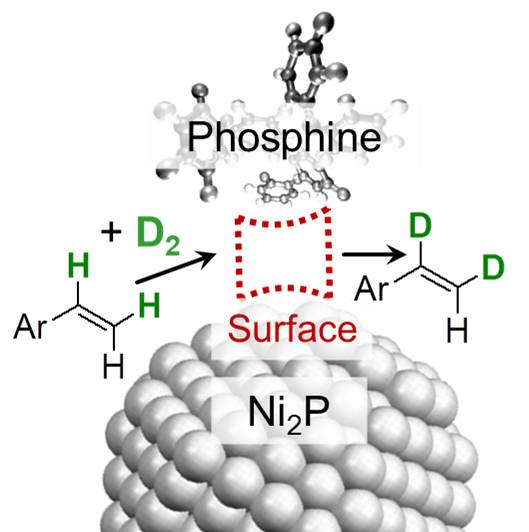
The project addresses two key challenges: reducing costs and improving selectivity to meet the needs of the pharmaceutical, medical diagnostics, and high-tech materials industries. The deuterated compounds market, projected to reach €1 billion by 2033, could thus become more accessible and sustainable.
Funding
This project has received funding from the European Research Council (ERC) under the European Union’s Horizon 2020 research and innovation programme (grant agreement No. ####).
 |
Related publications from the NanoFLP project
Frustrated Lewis pairs on nanoparticles for colloidal catalysis: dream or reality?
|
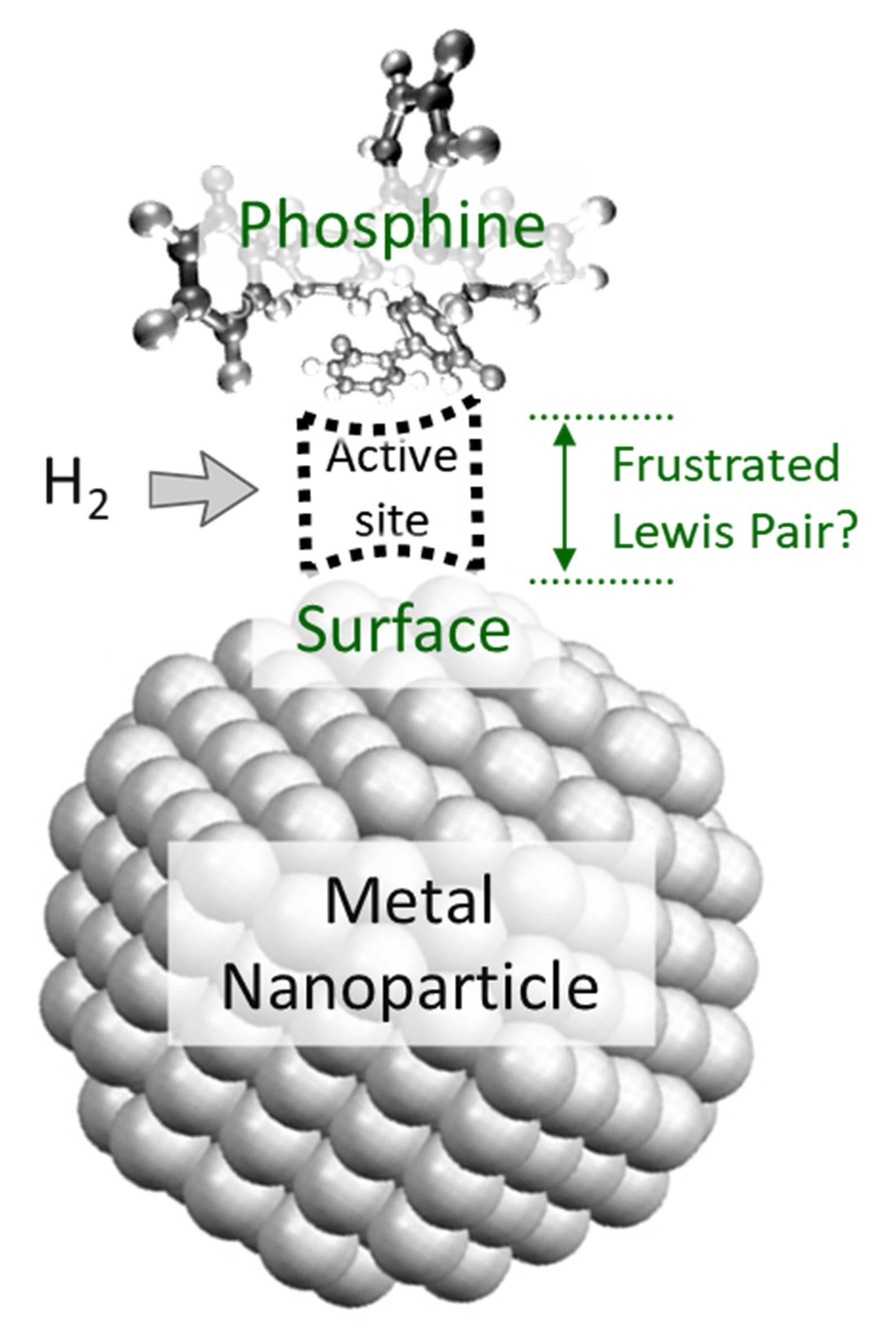
Catalysis by the colloidal suspension of nanoparticles has attracted considerable attention in recent years as it may combine interesting features: (i) the possibility of using inorganic catalysts, such as those of transition metal nanoparticles; (ii) the opportunity of adding well-designed ligands, as in homogeneous catalysis, to tune the activity and selectivity of a given reaction. Here, we propose and illustrate the design of metal nanoparticles in colloidal suspension as Lewis acid partners of a “NanoFLP”. This concept was explored for the hydrogenation of alkynes such as phenylacetylene. However, to this date, no direct proof for the occurrence of an FLP has been provided on the examples that we developed. We discuss possible interpretations of the experimental data and ways of clarifying the mechanism involved. |
 |
S. Carenco, Comptes Rendus. Chim. 2024, 27, 395–403. |
Structure Sensitivity, Magnetization, and Topological Analysis in DFT Models of Ni Nanoparticles and Surfaces Functionalized by Adsorbed Trimethylphosphine
|
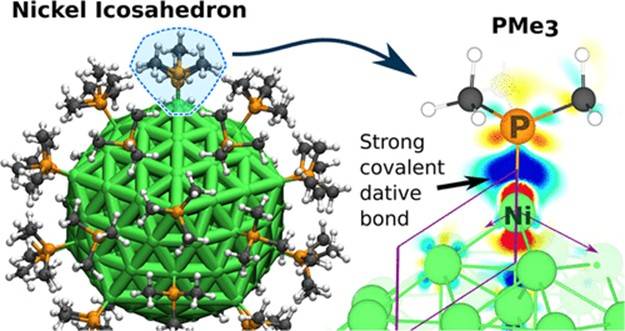
The adsorption properties of trimethylphosphine (PMe3) on Ni nanoparticles (NPs) and extended surfaces were investigated via spin-polarized dispersion-corrected density functional theory calculations. The coverage effect of phosphine was explored by considering monoadsorption and monoshells on NPs and various adlayers from low coverage to saturation on surfaces. Icosahedral, ino-decahedral, cuboctahedral, truncated octahedral, and Marks-decahedral Ni nanoclusters at a size of 146–147 atoms were compared to the Ni(111), (100), and (110) surfaces. |
 |
S. Godoy-Gutierrez, A. Ropp, K. Azouzi, J. Pilmé, S. Carenco, D. Loffreda, J. Phys. Chem. C 2024, 128, 16501–16513. |
Phosphines on Colloidal Nickel Nanocatalysts to Lower the Onset Temperature of Terminal Alkynes Hydrogenation
|
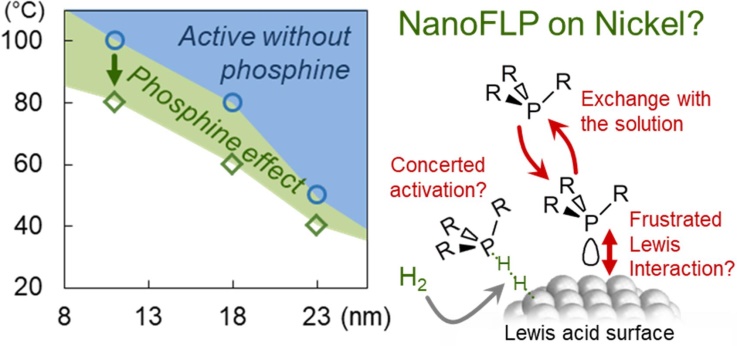
We show that phosphines with adequate steric hindrance (e.g., PnBu3 and PiBu3) lower the onset temperature for phenylacetylene hydrogenation by nickel NPs under 7 bar of H2, by ca 10 to 20 °C depending on the NP diameter. This result is of conceptual value because the hydrogenation may have been driven by the frustrated Lewis pair (FLP) between the Lewis basic phosphine and the Lewis acid nickel surface, forming a so-called “NanoFLP”. Moreover, we demonstrated that less than 2 phosphines per Ni surface atom are enough for the effect to arise. We showed that other terminal alkynes, like 1-octyne, can be hydrogenated with this method. |
 |
K. Azouzi, A. Ropp, S. Carenco, ACS Catalysis 2024, DOI 10.1021/acscatal.4c00054. |
Phosphine-Enhanced Semi-Hydrogenation of Phenylacetylene by Cobalt Phosphide Nano-Urchins
|
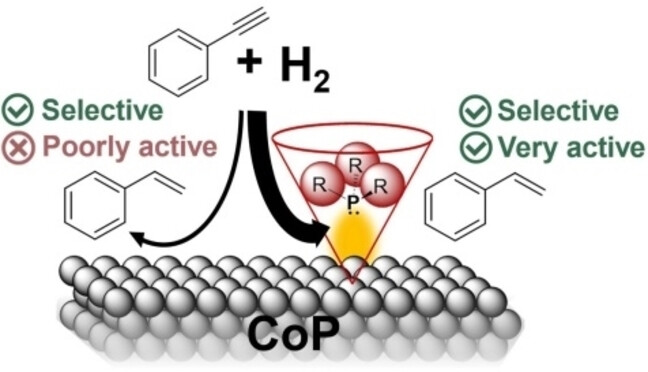
We report the positive effect of phosphine additives on the activity of cobalt phosphide nano-urchins for the semi-hydrogenation of phenylacetylene. While the nanocatalyst's activity was low under mild conditions (7 bar of H2, 100 °C), the addition of a catalytic amount of phosphine remarkably increased the conversion, e. g., from 13 % to 98 % in the case of PnBu3. A stereo-electronic map was proposed: the strongest effect was observed for low to moderately hindered phosphines, associated with strong electron donor abilities. |
 |
A. Ropp, R. F. André, S. Carenco, ChemPlusChem 2023, DOI 10.1002/cplu.202300469. |
Phosphines Modulating the Catalytic Silane Activation on Nickel-Cobalt Nanoparticles, Tentatively Attributed to Frustrated Lewis Pairs in a Colloidal Solution
|
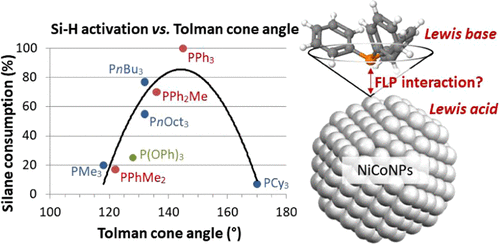
We propose the concept of a NanoFLP in a colloidal solution where one partner is a phosphine Lewis base and the other is the Lewis acid surface of a NiCo nanoparticle. We attempt to apply this concept to the hydrosilylative reduction of benzaldehyde. We identify a correlation between the Tolman cone angle and the silane conversion, consistent with both mechanisms; however, we found no clear correlation between the Tolman electronic parameter and the reaction outcome. Structural analyses evidenced that the nanoparticles are not altered during the reaction, which led us to propose the formation of a NanoFLP as a transient species in solution. |
 |
A. Palazzolo, S. Carenco. Chem. Mater. 2021, acs.chemmater.1c03105. |